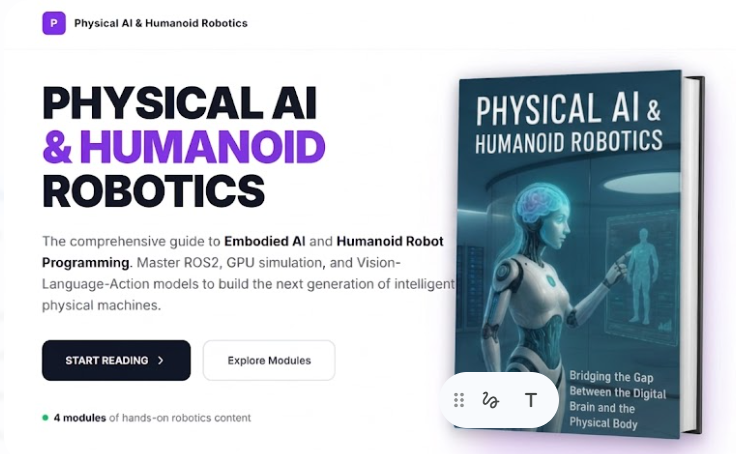
Executive Summary
This project answers a fundamental question: What will the book of tomorrow look like?
Today's digital books are simply scanned versions of print — they do not know who is reading, what the reader already knows, or what language they speak. This platform introduces a new model for educational content built around three core capabilities:
Adaptive Content
The platform asks users whether they are a beginner, intermediate, or advanced learner, then adjusts the entire book experience to match their level.
One-Click Urdu Translation
The full book translates to Urdu instantly, removing the language barrier for millions of readers across Pakistan, India, and the Middle East.
Book-Grounded Chatbot
An integrated AI assistant that answers questions exclusively from the book's own content — providing cited, accurate responses without hallucination.
"This is not just a robotics textbook. It is a working demonstration of how every educational book — medical, legal, engineering, or scientific — will function in the near future."
Problem Statement
Traditional educational books deliver identical content to every reader. In practice, learners arrive with vastly different backgrounds — a single static book cannot serve all of them effectively.
| Student | Background | Problem with a Static Book |
|---|
| Hamza | No prior programming experience | Advanced content is incomprehensible — he drops out |
| Sana | 3 years of Python experience | Basics she already knows waste her time |
| Ali | Professional software engineer | Cannot skip to advanced material without losing structure |
Beyond level mismatch, four additional pain points block learners:
| Problem | Impact |
|---|
| Language barrier — content in English only | Non-native English speakers struggle to absorb technical concepts |
| No built-in Q&A support | Students leave the book to search online, finding outdated or incorrect answers |
| Generic content structure | No recognition of the reader's hardware, OS, or prior knowledge |
| Broken code examples | Version mismatches in ROS 2 / Isaac Sim block student progress |
Solution: Three Core Features
During signup, users answer two targeted questions before accessing the book: their software background (Beginner / Intermediate / Advanced) and their hardware/OS. These answers create a persistent learning profile stored in the backend.
When the user navigates to the book, the skill level is embedded in the URL as a query parameter:
https://book.site/module1/intro?level=beginner
https://book.site/module1/intro?level=intermediate
https://book.site/module1/intro?level=advanced
The Docusaurus-based book reads this parameter and renders the appropriate version of each chapter. Beginners receive fuller explanations; advanced readers get direct access to theory, code, and edge cases.
Over 100 million Urdu-speaking students across Pakistan, India, and the Middle East face a compounding disadvantage: learning complex technical subjects in a second language. A single translation button eliminates this barrier entirely.
Every page includes an "اردو" button. On click: page content switches to Urdu, technical terms (ROS 2, URDF, Nav2) stay in original form, layout switches to RTL, and the preference is saved for all future visits.
| Region | Benefit |
|---|
| Pakistan | Urdu is the national language — removes the English technical barrier entirely |
| India | Large Urdu-speaking population gains full access to advanced technical content |
| UAE / Saudi Arabia | Pakistani and Indian diaspora in the Gulf can study in their mother tongue |
A student doesn't understand a concept in Chapter 4. They leave the book, search Google, ask ChatGPT — and receive an outdated or incorrect answer. The student loses trust and momentum.
The integrated AI assistant reads only this book and answers only from its content — with a citation pointing to the exact chapter and section.
User submits a question
        ↓
OpenAI Embeddings  →  question converted to a vector
        ↓
Qdrant Vector DB   →  semantically similar book passages retrieved
        ↓
RAG Pipeline       →  retrieved context + question sent to GPT-4
        ↓
Response generated →  answer + citation (chapter, section, page)
        ↓
PostgreSQL         →  conversation saved for continuity
| Service | Responsibility |
|---|
openai_service.py | Text embeddings and GPT-4 response generation |
qdrant_service.py | Vector similarity search across indexed book content |
postgres_service.py | Conversation history — store and retrieve by session |
rag_service.py | Orchestrates the full pipeline end to end |
System Architecture
┌──────────────────────────────────────────────────────────────┐
│                        USER JOURNEY                          │
│                                                              │
│   Landing Page  →  Signup (2 questions)  →  Dashboard       │
│                           ↓                                  │
│                  Learning Profile Saved                      │
│                           ↓                                  │
│          Book URL  +  ?level=beginner / intermediate /       │
│                           advanced                           │
│                           ↓                                  │
│         ┌─────────────────────────────────────┐             │
│         │           ADAPTIVE BOOK             │             │
│         │     Docusaurus v3 · GitHub Pages    │             │
│         │  • Level-appropriate content        │             │
│         │  • One-click Urdu translation       │             │
│         │  • Embedded chatbot widget          │             │
│         └──────────────────┬──────────────────┘             │
│                            │                                 │
│              ┌─────────────▼──────────────┐                 │
│              │       RAG CHATBOT          │                  │
│              │     FastAPI Backend        │                  │
│              │  OpenAI · Qdrant · PG      │                  │
│              └────────────────────────────┘                 │
└──────────────────────────────────────────────────────────────┘
| Layer | Technology |
|---|
| Frontend | Next.js 14 + TypeScript + Tailwind CSS |
| Authentication | Better Auth (signup, signin, session management) |
| Backend API | FastAPI (Python) |
| AI / LLM | OpenAI GPT-4 + text-embedding-3-small |
| Vector Database | Qdrant (indexed book content embeddings) |
| Relational Database | PostgreSQL (users, learning profiles, conversations) |
| Book Platform | Docusaurus v3 — multi-instance (main site + 4 modules) |
| Deployment | Vercel (frontend) · Render (backend) · GitHub Pages (book) |
Complete User Flow
New User
- Arrives at the landing page
- Clicks "Sign Up"
- Step 1: Name, email, password
- Step 2: Selects skill level + hardware/OS
- Account created — learning profile saved
- Redirected to personalized dashboard
- Clicks "Start Reading" → book opens at correct level
Active Reader
- Reads a chapter at their skill level
- Encounters a concept they don't understand
- Opens chatbot — asks a question in plain English
- Receives an answer from the book + a citation
- Clicks "اردو" — page switches to Urdu
- Language preference saved for all future visits
Returning User
- Signs in — session restored instantly
- Dashboard loads with saved profile and level
- Book resumes — Urdu preference remembered
- Chatbot conversation history accessible
Challenges & Solutions
Collecting user level without friction
2-step signup — level selection happens before the user ever touches the book
Passing level context to the book
?level= query parameter appended to every book URL from the dashboard
Chatbot hallucination
RAG architecture — GPT-4 only generates from Qdrant-retrieved passages
Indexing a large book
Book content chunked into semantic passages and embedded into Qdrant
Urdu RTL layout
CSS dir="rtl" toggled dynamically on translation activation
Conversation continuity
PostgreSQL stores full conversation threads by UUID session
Auth & profile synchronization
Better Auth session token passed to FastAPI — profile fetched on every dashboard load
Projected Impact
10,000+
Learners in 5 years
100%
Answers sourced from book — zero hallucination
90%+
Students find their level appropriate
70%
Fewer support tickets vs. static textbooks
80%
Capstone project completion target
The platform also compares favourably against traditional digital books on every dimension:
| Dimension | Traditional Digital Book | This Platform |
|---|
| Audience awareness | None — same for everyone | Knows the reader's level from signup |
| Content delivery | Fixed | Adapts to beginner / intermediate / advanced |
| Language | English only | English + one-click Urdu |
| Questions | Reader goes to Google | Built-in chatbot, answers from the book |
| Answer quality | Unverified, potentially outdated | Cited, grounded in book content only |
| Interactivity | Passive reading | Active conversation with the content |
Roadmap
HighLive Urdu translation via OpenAI APIv1.1
HighPer-chapter progress trackingv1.1
MediumAdaptive quizzes after each sectionv1.2
MediumArabic translation buttonv2.0
HighBrowser-based ROS 2 simulation (WebAssembly)v2.0
HighMulti-book platform — extend to any subjectv3.0
Want an adaptive AI platform for your content?
We build intelligent educational systems that know who the learner is and adapt to serve them perfectly.